 Aka Journal
André Krischak und Lucy Gillmann 🙂
Abstract
Previous research has examined gender role-related characteristics in the linguistic features of rap lyrics, with a particular focus on female rappers and the language associated with gangsta rap. The research underlying our study primarily uses corpus-based methods with collections of song lyrics to identify patterns and differences in language use between male and female artists. Building on these approaches, our paper investigates gender-related differences in the use of curse words and taboo address terms in rap lyrics, while also examining listeners’ attitudes towards these linguistic variations. By combining corpus analysis with survey data, we aim to explore not only how the gender of the artist may influence the use and perception of such linguistic features, but also to what extent the gender of the listener influences their attitudes towards them.
1. Introduction
Language is a fundamental means of communication and is closely connected to social and cultural identity. Sociolinguistics examines how language use varies according to social factors such as gender and context (Wardhaugh 1). One particularly expressive aspect of language is profanity, which can reflect emotions, identity, and social norms. Its use is especially prominent in popular culture, where language often plays an important role in self-expression. (Jay 267)
Rap music provides a good example for examining profanity, as the genre is known for its direct, expressive, and often explicit language. This study therefore examines gendered differences in the use of profanity in rap music and investigates how listeners perceive these differences.
2. Literature Review
2.1. Definitions
Rap is a musical and linguistic form that developed as part of hip-hop culture in the United States during the 1970s. It emerged particularly in African American and Latino communities in the Bronx, New York City. Rap is characterized by rhythmic speech, rhyme, wordplay, and the use of language to express personal experiences, social issues, identity, and cultural perspectives. During the 1980s and 1990s, rap became increasingly popular in mainstream music and developed into a highly diverse genre. Today, rap encompasses many different styles and themes and is performed by artists of different genders, ethnicities, and social backgrounds. (Wikipedia n.p.)
Since rap as an art form is strongly connected to questions of identity and self-expression, the role of sex and gender is particularly relevant when examining how rap is created and perceived. Sex and gender are related but distinct concepts. Sex generally refers to biological characteristics, such as reproductive anatomy, chromosomes and hormones, whereas gender refers to socially and culturally constructed roles, behavior and expectations associated with being male, female or another gender. (Wikipedia n.p.)
In sociolinguistics, gender is particularly relevant because people may use language differently depending on social expectations and gender identities. Research on language and gender has shown that linguistic behavior can contribute to the construction and expression of gender. In the context of rap, gender can therefore influence both the way artists use language and the way their language is perceived by listeners.
Curse words, also referred to as “swear words”, “profanities” or “taboo words”, are words and expressions that are considered offensive, inappropriate or socially unacceptable in a particular context or community. Their meanings and levels of offensiveness are not fixed; they can change depending on the social situation, the speaker, the listener, and the cultural context. Historically, swear words have often been associated with topics considered taboo, such as religion, sexuality, bodily functions or insults. In modern popular culture, including rap, curse words are frequently used as a stylistic and expressive device. They can communicate emotions such as anger, emphasis, or excitement, but they can also contribute to humor and group identity (Jay 268).
Another important linguistic feature that can reveal social relationships and attitudes in rap is the use of address terms. Address terms are words or expressions used to refer to or directly address another person. Examples include terms such as bro, dude, girl, man, bitch, sir or darling. Address terms can communicate social relationships ranging from affection to hostility. Their interpretation strongly depends on context. In modern language, address terms can also express gender and social identity. This is particularly relevant in rap, where terms such as bro, bitch or girl may be used to construct identities or reinforce gender stereotypes.
2.2. Previous Studies
The relationship between language, gender, and rap music has already been examined from different linguistic perspectives. Previous studies have focused on the pragmatic functions of swearing rather than simply treating swear words as inherently rude. The results revealed that factors like the relationship between speaker and listener, social situation and gender can influence how offensive an expression is received. This provides a theoretical basis for investigating whether the gender of a rapper influences listeners‘ attitudes towards the same linguistic expression.
A different study focuses on the ways in which these artists use language that is traditionally considered “unladylike”, such as profanity, sexual language and aggressive expressions, demonstrating that the use of offensive or gendered language in rap can be connected to the construction of gender identity (Haugen 429)
Despite these important findings, there is still a research gap regarding the question whether the same curse word or address term is perceived differently depending on whether it is used by a male or female rapper.
2.3. Research Questions
Previous research has provided valuable insights into the relationship between language, gender, and rap music. However, there is still a research gap regarding the differences, perception, and evaluation of linguistic features, such as curse words and address terms, in relation to the gender of the speaker. To address this gap and gain a more comprehensive understanding of this relationship this paper focuses on:
- the differences in the use of curse words and address terms between male and female artists in rap music
- how listeners evaluate these differences
- a possible correlation between the gender of the listeners and their attitudes towards these language characteristics
3. Methodology
3.1. Corpora
To investigate gender-related differences in the use of language in rap music, our study employs a corpus-based approach. We constructed a corpus consisting of rap lyrics by male and female artists and selected the three most popular male and female artists based on the rankings provided by Wikipedia (Wikipedia n.p.). For each artist, we selected their five most popular songs according to Genius, resulting in a collection of 30 songs in total. (Genius n.p.)
We analyzed the lyrics of these songs for the occurrence of curse words and taboo terms using Antconc and Excel. Collaborations were only included if all artists performing were of the same gender. At times where this wasn’t the case, the data was excluded since this would distort the results. Lastly, we separated our findings of „Curse words“ into three categories: General profanity, Gendered and sexualized taboo terms and Racial slurs.
3.2. Survey
We additionally conducted an online survey focusing on listeners’ attitudes towards rap lyrics regarding the gender of rap artists. The survey consisted of short excerpts from rap songs by both male and female artists. The excerpts contained examples of linguistic features such as curse words and address terms.
- Example 1 (male): „Stunting, popping bottles / Getting drunk with these bitches“ – Lil Wayne
- Example 2 (female) „Freaky lil’, sneaky lil’, creepy lil’ whack bitch / Creepin’ on me, speakin’ on me, sleepin’ on me, mattress“ – Doechii
- Example 3 (male): „You a fine motherfucker, won’t you back that ass up? / Call me big daddy, won’t you back that ass up?“ – Drake
- Example 4 (female): „Just take the pain and let that motherfucker burn / And you know that in time you will find / That they always come back, yeah they always come back“ – Ella Eyre
After reading each excerpt, participants were asked to evaluate the language using the following questions:
- „Wie angemessen findest du die Verwendung des Begriffs bitch / motherfucker in diesem Ausschnitt?” (How appropriate would you rate the use of the term bitch/ motherfucker in this extract; our trans.).
- Wie beleidigend empfindest du die Verwendung des Begriffs bitch/ motherfucker in diesem Ausschnitt? (How offensive would you rate the use of the term bitch/ motherfucker in this extract; our trans.).
- Wie natürlich wirkt die Verwendung des Begriffs bitch/ motherfucker in diesem Ausschnitt auf dich? (How natural would you rate the use of the term “bitch/ motherfucker” in this extract; our trans.).
This allowed us to compare participants’ attitudes towards the same or similar linguistic features depending on the gender of the rapper. Furthermore, we collected basic demographic information, including the participants’ gender, to examine whether the listeners’ own gender may influence their responses.
4. Results
The corpus analysis revealed noticeable differences in the use of curse words between the male and female artists in our sample of 3375 words. Overall, 285 occurrences of the selected terms were identified in the 15 songs by female artists, compared with 227 occurrences in the 15 songs by male artists.
The most striking difference can be observed for the term bitch(es). It occurred 87 times in the female corpus, compared with only 14 occurrences in the male corpus. Similarly, pussy occurred 16 times in the female corpus but did not occur at all in the male corpus. Other gendered terms such as dick(s) and whore(s) were also more frequent among female artists.
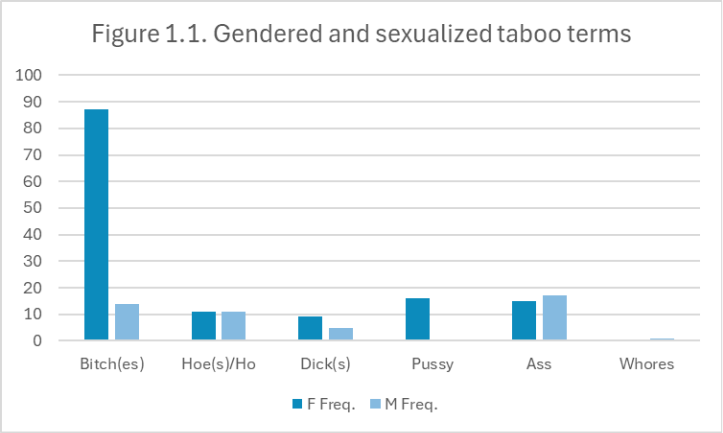
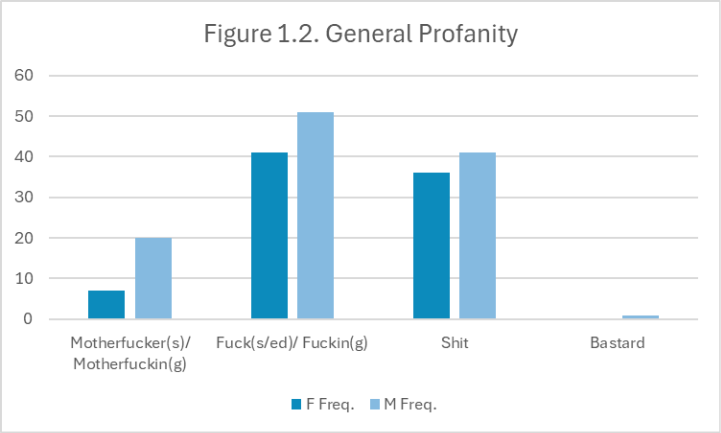
In contrast, several more general profanity terms were more frequent in the male corpus. Motherfucker(s), fuck(s)/fucking, and shit all occurred more often among male artists, although the differences were not equally pronounced. Other terms, such as hoe(s)/ho, ass, and the N-word, showed relatively similar frequencies across the two corpora. However, the use of the N-word should be interpreted with caution, as the racial composition of the two groups differed: only two-thirds of the male rappers were Black, whereas all female rappers were Black.
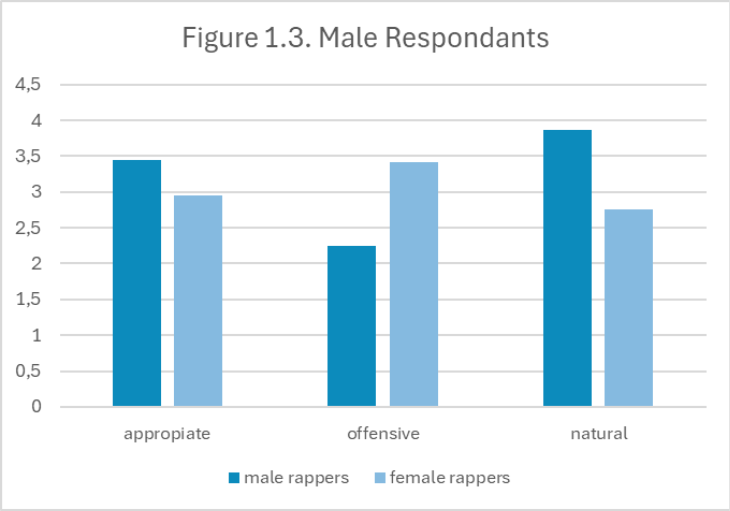
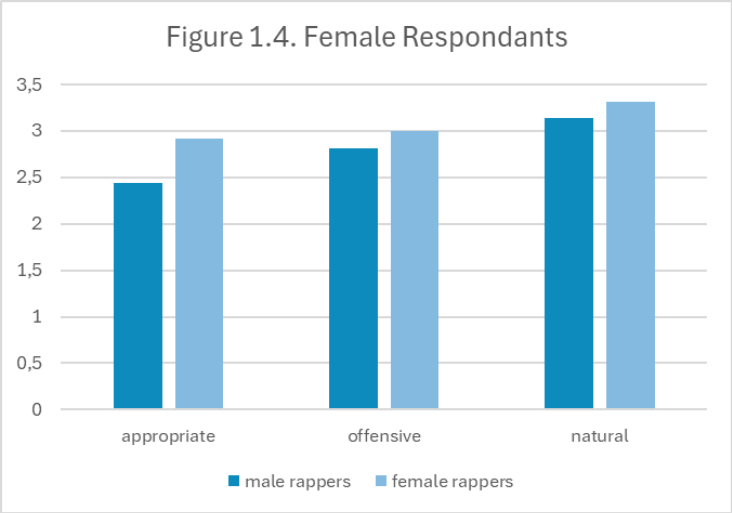
The survey comprised 65 participants, including 29 male and 36 female respondents. Overall, the results indicate that evaluations of offensive language varied according to both the gender of the rapper and the gender of the listener. Among male respondents, profanity used by male rappers generally received higher naturalness and appropriateness ratings than the same or similar language used by female rappers. In contrast, language used by female rappers tended to receive higher offensiveness ratings, particularly among male respondents. Female respondents showed a similar tendency, although the differences were generally less pronounced.
The largest difference between male and female respondents was observed in their appropriateness ratings of bitches used by a male rapper. Male respondents evaluated this usage considerably more positively than female respondents. Overall, the findings suggest that the perceived naturalness, appropriateness, and offensiveness of profanity are influenced not only by the type of profanity used but also by the gender of both the rapper and the listener.
5. Discussion
5.1. Corpora
The findings suggest that there are differences between the linguistic categories and types of taboo expressions male and female rap artists use. Female artists in our sample frequently used gendered and sexualized terms such as bitch and pussy, whereas male artists showed some higher frequencies of general profanity and racial slurs such as fuck, shit, motherfucker and the N-word.
The observed differences may reflect gendered patterns of taboo language. Female artists’ more frequent use of gendered and sexualized terms such as bitch and pussy may represent ways to find empowerment in sexuality, including the reappropriation of derogatory terms which oftentimes results in utilizing female sexuality as a means of provocation (Vinter 32). In contrast, male artists’ higher use of general profanity may be associated with linguistic performances of toughness, aggression, or masculinity. (Holmes 169)
Despite the vocabulary differences in their use of curse words, female and male rappers employ curse words at relatively similar rates because general profanity has become an established linguistic feature of the genre rather than a strongly gender-specific one. Artists can intensify statements, create a provocative effect, and contribute to the confrontational style often associated with the genre. Insults may also be used for self-presentation, competition, or expressing dominance in the lower class.
Rap music is associated with the lower class because it originated in marginalized, low-income urban neighborhoods. Women in both the lowest and highest social groups tend to speak more similarly to men within the same social group than to women from other groups. This might suggest that social class membership may have a stronger influence on speech patterns than gender identity in these groups.
5.2. Survey
The results suggest that listeners’ attitudes towards offensive language in rap are influenced by both the gender of the rapper and the gender of the listener. The clearest pattern can be observed among male respondents. They consistently rated offensive language used by male rappers as more appropriate and more natural, while evaluating the same or comparable language used by female rappers as more offensive and less natural. For example, motherfucker was rated as highly natural when used by a male rapper (M = 3.86), but considerably less natural when used by a female rapper (M = 2.76). At the same time, its perceived offensiveness increased from 2.24 to 3.41. A similar pattern can be observed for bitch(es). This suggests that the evaluation of a swear word is not determined by the lexical item alone but is also influenced by the person using it.
One possible explanation for the differences among male respondents is the association between non-standard or strongly marked language and masculinity. Sociolinguistic research has repeatedly found that men tend to use more stigmatized or non-standard linguistic forms than women, while such forms can carry positive associations with masculinity, informality, or group solidarity (Holmes 164). This could help explain why male respondents in our survey perceived swear words as more natural when they were used by male rappers. Since offensive and non-standard language is strongly established within rap as part of a particular linguistic style, male rappers using such language may therefore appear more consistent with listeners’ expectations of the genre.
The comparatively negative evaluation of female rappers by male respondents may also reflect gender expectations. Women are traditionally associated with more prestigious or less stigmatized forms of language in sociolinguistic research. This does not mean that women are inherently less likely to use swear words, but rather that social expectations can affect how their language is perceived and evaluated. Consequently, identical offensive language may appear more marked when used by a female speaker than by a male speaker. In the context of rap, this may be particularly relevant because the genre has historically been strongly associated with masculine identities and forms of hegemonic masculinity. Research on rap lyrics has also identified recurring gendered representations and has shown that male and female rappers can position themselves differently in relation to gender, power, and sexuality. (Holmes 164)
The results for female respondents are more mixed. Female participants generally rated language by male rappers as less appropriate than male participants did, but they did not show the same strong negative shift when the rapper was female. Most notably, motherfucker was rated as more appropriate and more natural when used by a female rapper than when used by a male rapper. This may indicate that female listeners are less likely to judge the use of offensive language negatively simply because it is produced by a woman, which does not necessarily imply that women prefer female rappers over male.
The finding that bitch remained comparatively offensive when used by a female rapper is particularly interesting. Unlike more general swear words, the term has an explicitly gendered meaning and is historically associated with the derogatory characterization of women. Gendered derogatory language, particularly terms referring to women, forms part of the genre’s wider negotiation of gender and power. Therefore, the relatively high offensiveness ratings for bitch may reflect not only the use of profanity itself but also the gendered meaning attached to the term. At the same time, its relatively high naturalness rating among female respondents could indicate that the term has become familiar within modern rap culture, even when it continues to be perceived as offensive (Vinter 31).
6. Conclusion
Overall, the findings of our corpus research suggest that the language use of male and female artists differ in the linguistic categories and types of taboo expressions they use. While female artists tend to incorporate more gendered and sexualized terms, male artists used general profanity and racial slurs more frequently.
On the other hand, the results of the survey reveal that offensive language in rap is evaluated through a combination of linguistic and social factors. The gender of the speaker appears particularly relevant for male respondents, who evaluated offensive language more positively when it was produced by male rappers. For female respondents, the pattern was less consistent, suggesting that listener gender may interact with speaker gender rather than producing a simple male-versus-female difference. The results therefore support the idea that attitudes towards rap lyrics are socially constructed and that the same linguistic form can receive different evaluations depending on who uses it.
Nevertheless, the findings should be interpreted with caution. The sample consisted of only 65 participants, and the survey used a limited number of lyric excerpts and individual swear words. In addition, the words differed grammatically between extracts (bitch and bitches), and the specific artists, lyrical contexts, and surrounding lyrics may also have influenced participants’ evaluations. The results therefore cannot demonstrate that gender alone caused the observed differences. Instead, they provide evidence of clear patterns in the attitudes of this sample and suggest that speaker gender and listener gender are relevant variables for further research on language attitudes towards rap.
7. Sources:
Genius Media Group Inc. (2024). Genius | Song Lyrics & Knowledge. Genius. https://genius.com/
Haugen, Jason D. „“Unladylike divas”: language, gender, and female gangsta rappers.“ Popular Music and Society 26.4 (2003): 429-444.
Holmes, Janet. An introduction to sociolinguistics. Routledge, 2013.
Jay, Timothy, and Kristin Janschewitz. „The pragmatics of swearing.“ Journal of politeness research: language, behavior, culture 4.2 (2008): 267.
Kreyer, Rolf. „“Funky fresh dressed to impress”: A corpus-linguistic view on gender roles in pop songs.“ International Journal of Corpus Linguistics 20.2 (2015): 174-204.
List of best-selling female rappers. (2024, February 12). Wikipedia. https://en.wikipedia.org/wiki/List_of_best-selling_female_rappers
Mejia, Gil Emanuel A., and Cristy Grace A. Ngo. „Profanity in social media: An analysis of pragmatic functions and politeness maxims violation.“ Journal Corner of Education, Linguistics, and Literature 4.1 (2024): 92-117.
Wardhaugh, Ronald, and Janet M. Fuller. An introduction to sociolinguistics. John Wiley & Sons, 2021.
Wikipedia Contributors. (2019, May 3). Rapping. Wikipedia; Wikimedia Foundation. https://en.wikipedia.org/wiki/Rapping
Wikipedia Contributors. (2023, March 12). Sex–gender distinction. Wikipedia; Wikimedia Foundation. https://en.wikipedia.org/wiki/Sex%E2%80%93gender_distinction
Wikipedia Contributors. (2023, December 12). Billboard and Vibe’s 50 Greatest Rappers of All Time. Wikipedia; Wikimedia Foundation. https://en.wikipedia.org/wiki/Billboard_and_Vibe%27s_50_Greatest_Rappers_ofAll_Time
Hi, Test test