 Aka Journal
Grete Eichenlaub
Pavel Rodionov
1. Introduction
1.1. Linguistics
Linguistics is the study of language with the aim to find explanations and definitions for linguistic phenomena (Linke, Nussbaumer and Portmann, 1). Five core branches which can be looked at when studying language, are “phonetics (namely the study of speech sounds in general), phonology (the study of the sound systems of individual languages), morphology (the study of the creation, structure and form of words), syntax (the study of structural units larger than one word, i.e. phrases and sentences) and semantics (the study of word and sentence meaning)” (Bieswanger and Becker, 2-3). As there have appeared more branches of linguistics in recent years we will define those ones, which were essential for our research. Sociolinguistics is the study of the relationship between language and society and corpus linguistics is the linguistic study that uses corpora for its research. Corpus related research is interested in the use of utterances used in common language, such as letters or conversations, (Bieswanger and Becker, 2-3).
1.2 Pragmatics
The most important aspect in communication is that the interlocutors understand what each of them wants to achieve with an utterance and are able to react in an appropriate way. The time and location of a conversation also influence these reactions. Pragmatics is the subdiscipline of linguistics which analyses how language can be used as a means of communication and in which way one can use it in order to fulfill a communicative goal. By expressing an utterance one wants to give information to an interlocutor, evoke or express certain feelings (Linke, Nussbaumer and Portmann, 9-10). It aims to examine the general linguistic rules, which define when and how language functions in common usage and how one can misinterpret an utterance. A common example for the difference between semantic and the pragmatic meaning of a sentence is: Do you have a watch?. The semantic meaning is that the speaker wants to know if the interlocutor has a watch and the pragmatic meaning is that the speaker wants the interlocutor to tell them the time (Linke, Nussbaumer and Portmann, 9-10). Our research question is part of this subdiscipline, because modal verbs can be analysed by looking at their pragmatic function. They allow us to express politeness and convey a more positive opinion on our utterances or emphasize our communicational intention.
2. Literature review
2.1. Politeness
For our analysis of the frequency of modal verbs used to express politeness, we define politeness according to Brown and Levinson. They propose that every person has “face”, which is something that can be lost through humiliation or embarrassment, but also maintained or enhanced. They differ between (a) negative face and (b) positive face. The negative face is “the basic claim to territories, personal preserves, rights to non-distraction”- everyone’s right for a personal space and independence.The desire of being accepted as a part of society and being approved by other people can be described as the positive face (Brown and Levinson, 311).Understandably everyone has the desire to maintain or defend their face and the interlocutors usually aim to “maintain each other’s face” (Brown and Levinson, 312) by respecting the social policies and norms. In relation to that they differ between (a) positive politeness and (b) negative politeness (Brown and Levinson, 317). By using positive politeness the interlocutors show their respect towards each other and that they consider themselves as part of the same group (Brown and Levinson, 317). On the other hand the negative politeness is connected to the want of showing that the speaker “respects the addressee’s freedom of action” and won’t interfere with it (Brown and Levinson, 317). They also introduce the “intrinsic face threatening acts (FTAs)” are used to define the act of threatening someone else’s face – i.e. disrespecting or harassing a person (Brown and Levinson, 313). They differ between FTAs that threaten the positive face, such as the “expression of disapproval, criticism, […] accusations, insults […]”, since these indicate that the speaker does not recognise the addressee as an equal. “Suggestions and advice”, are examples for threatening “negative face”, because the speaker could possibly use those acts to harm the addressee (Brown and Levinson, 313). When speaking, it is difficult to always avoid these FTAs, but they can be minimized by going “on record“, since it allows the speaker to show their “communicative intention“, that led them to threaten face (Brown and Levinson, 316). Going “off record“ implies that the speaker’s intentions are unclear and their act of threatening face can not be justified (Brown and Levinson, 316).
2.2. Modal verbs
We will use the definition for modal verbs of the Cambridge Dictionary “a verb used with another verb to express an idea such as possibility that is not expressed by the main verb: The modal verbs in English are can, could, may, might, must, ought, shall, should, will, and would.” (Cambridge Dictionaries (Online)). The usage of modal verbs in phrases and sentences can possibly be face threatening (Boicu, 1) since most of them are used to express orders, requests, suggestions and advice, which threaten the addressee’s negative face, as they are intrusive.(Brown and Levinson, p. 313). Hedging is the linguistic phenomenon that “softens the force of expressions regarding power relations between interlocutors” (Salager-Meyer, 149─150) and can be realized by modal verbs as they convey politeness and respect between interlocutors. The way modal verbs are analysed for expressing politeness depends on what the aim of the analysis is. Nozawa examined the appearance of “polite request modal verbs” in textbooks. Her conclusion was that only 11% of the modal verbs used expressed politeness (Nozawa, 5), which was an important finding for our study of the frequency of modal verbs used to express politeness.
3. Methodology
3.1 Corpora-based research
Corpora as an empirical method of studying the specifics of a language are appropriate for studying language variation, because they allow for the analysis of the language in its natural setting rather than relying on constructed examples. This is imperative for this study, because the way modal verbs are interpreted heavily depends on the context they were presented in. Thus, by examining texts in their spoken context, we can derive the pragmatic function they fulfill, such as politeness. The present study focuses specifically on the differences between British spoken English and Canadian spoken English. To achieve this, two corpora are chosen: ICE-GB-Spoken with 1,987,828 word tokens and ICE-CAN-Spoken with 1,032,216 word tokens. The ICE corpora were made for comparability between different instances of speech. Therefore, both corpora build a stable foundation of spoken texts that are suitable to examine the differences between both regions with a reasonable accuracy. However, due to the scope of this study, a random sampling procedure is chosen. Thus, 20 occurrences of every modal verb of the five in each corpus are extracted, resulting in a total of 200 modal-verb-occurences overall. Because we used AntConc to find the verbs, we can not safely determine the meaning of can and might, namely whether these were used as nouns or verbs within the sampled 200, however, it was ensured that every occurrence does indeed serve as a verb. To give some context, the frequency of every modal verb in either of the corpora is seen in Table 1.1. in words per million.
| Can | Could | May | Might | Would | |
| Great Britain | 2151 | 893 | 372 | 503 | 1618 |
| Canada | 2044 | 900 | 310 | 324 | 1479 |
Table 1.1. Number of times every modal verb appears in both corpora in words per million, rounded down.
3.2. Statistical Analysis
Each of the 200 modal-verb-occurences are manually reviewed and discussed to determine whether the modal verb acts as a means to achieve politeness. The classification of politeness-oriented function is based on the framework set by Brown and Levinson. Thereafter, the data is exported into R Studio to be analysed for statistical relevancy. The software can be used to calculate frequencies and test hypotheses, e.g. by using the chi-squared test.
4. Results
As seen in Table 1.1 the “words-per-million” frequency of every verb is almost identical between the British and the Canadian corpus, with can being the most frequently used one in both regions, averaging at about 2100 words per million across both corpora. Could appears approx. 900 times, may approx. 340 times, Would approx. 1550 times both in BrE and in CanE. However, the verb might appears less often in Canadian speech than in their British counterpart. The relation of all other modal verbs in words per million is approx. 1:1, see Table 1.1. Might appears 503 times among the million in BrE and only 324 times in CanE, which breaks the pattern that is seen for other modal verbs. It is also important to note that every modal verb with the exception of could appears more often in BrE.
Focusing on the random subsample has shown some differences between the two analysed datasets. These can be seen in Figures 1.1 and 1.2 below, as well as in Table 1.2.
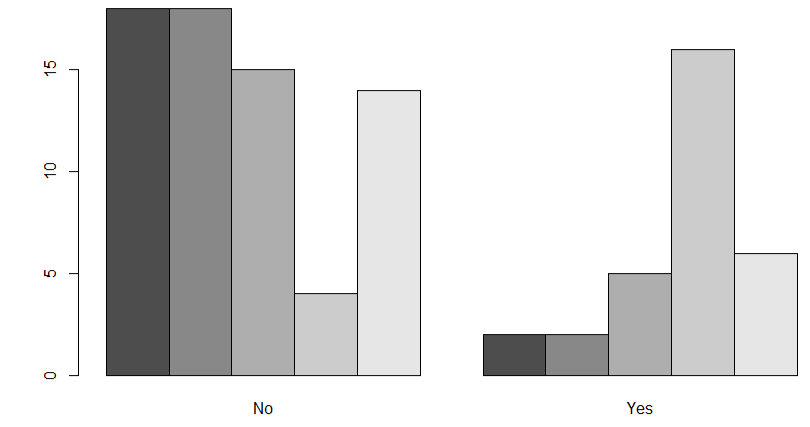
Figure 1.1. The usage of can, could, may, might, would from left to right in Canadian English, left columns are for politeness-oriented modal verbs, right ones for the opposite, number on y-axis is the total number of verbs.
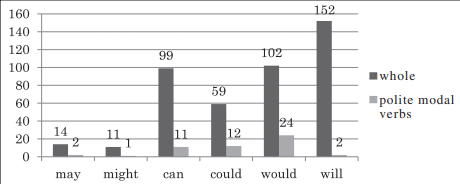
Figure 1.2. The usage of can, could, may, might, would from left to right in Canadian English, left columns are for politeness-oriented modal verbs, right ones for the opposite, number on y-axis is the total number of verbs.
As seen in Table 1.2, in CanE, 31% of the time the verbs were used with the aim of politeness, in British English it was in 22% of all the cases. Both datasets have been tested for statistical significance using the built-in tools of R, resulting in the following values: X-squared = 1.6429, df = 1, p-value = 0.1999 Among all of the verbs, only might is seen to be crucial for politeness when it’s being used. With 80% in Canadian and 50% in British English, it is the verb that is most often used for that purpose. Another example is would, which has 30% and 20% respectively. Thus, all other modal verbs are for the most part not dominant in politeness-oriented speech, most notably with can at only 10% and 5% respectively, proving it to be somewhat irrelevant in that regard.
| Total | Can | Could | May | Might | Would | |
| Canadian | 31% | 10% | 10% | 25% | 80% | 30% |
| British | 22% | 5% | 20% | 15% | 50% | 20% |
Table 1.2 – Relative frequency of politeness-oriented usage of the modal verbs in Canadian and British English.
5. Discussion
What we can derive from these results, is that, although they are statistically insignificant, there might be qualitative difference between the usage of modal verbs as a tool for politeness in British and Canadian Englishes. Namely, CanE speakers use politeness-oriented modal verbs slightly more often than BrE speakers do, even though BrE speakers use modal verbs more often in general. CanE speakers do this about 41% more times than BrE speakers do. One possible reason would be that these differences are influenced by the structural differences in linguistic conventions and language use between the people in Canada and Britain. This would also explain the tendency of using certain modal verbs, in our instance might, a lot more often and a lot more casual than their counterpart. Therefore, might appears about twice as often in British English and is so rarely used with the goal of politeness. Similar statements can be made about other modal verbs, can, for example, is used twice as often with a politeness-oriented goal by Canadian speakers than by British ones. However, it is the opposite for could, which could possibly indicate that British speakers rather use could, while Canadian speakers prefer can, when trying to be polite. This hypothesis has its own flaws, namely that both verbs are used almost equally by British speakers and Canadian speakers, as seen in Table 1.1. When comparing our results with those of Yokako Nozawa in her paper “An Analysis of the Use of Modal Verbs in EFL Textbooks in Terms of Politeness Strategy of English”, we find the following differences: EFL textbooks use polite modal verbs a lot less than BrE and CanE speakers do. Her findings, however, primarily focused on a different target group, namely on English textbooks in Japan. Therefore the differences to our study are to be expected.
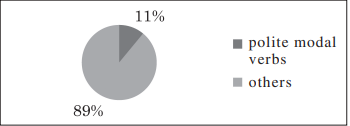
Fig. 1.3. The percentage of politeness in all modal verbs in EFL textbooks (Nozawa)
Fig. 1.4. Types of modal verbs (Nozawa)
6. Conclusions
6.1. Conclusion
By analysing two separate corpora and comparing selected elements of one to those of the other, it was revealed that, quantitatively, CanE speakers use politeness-oriented modal verbs more often than BrE do. Moreover, there are some parallels to previous studies on different regional dialects of English regarding modal verb usage. This paper opens up space for further research with the aim of improving the methods used, as well as further backing up the original hypothesis. A better interpretation would be the difference in perception, rather than a tendency to use one verb over the other, this however requires further research, for which this paper should work as a foundation.
6.2. Limitations
It is important to note that the results of our study are not entirely representative. Even though our findings support our original hypothesis, we can not confidently expand it to all British and Canadian speakers. While the choice of corpora is fully reasonable due to the lack of homogeneity of the texts presented therein, we can not disregard the potential problem of the method used. There is no guarantee that the selected 20 occurrences of each verb have to be fully representative and further studies with larger sample data might prove useful in order to further research this topic.
7. References
Bieswanger, Markus and Becker, Annette. Introduction to English Linguistics. Tübingen, Narr Francke Attempto, 2021.
Boicu, Ruxandra. “Modal verbs and politeness strategies in political discourse.” Analele Universității din București, Vol. LVII (57), No. 1 / 2008, 2007, pp. 15-28.
Brown, Penelope, and Levinson, Stephen C. “Politeness: some universals in language usage.” The Discourse Reader, edited by Adam Jaworski and Nikolas Coupland, Routledge, 1987, pp. 311-323.
Linke, Angelika, Nussbaumer, Markus, and Portmann, Paul R. Studienbuch Linguistik. Tübingen, Max Niemeyer, 2004.
Nozawa,Yukako. “An Analysis of the Use of Modal Verbs in EFL Textbooks in Terms of Politeness Strategy of English.” Global Journal of Foreign Language Teaching, 2014, pp. 39-47.
Salager-Meyer, Françoise.”Hedges and textual communicative function in medical English written discourse.“ English for Specific Purposes, Vol. 13/2, 1994, pp. 149-170.